In recent years, the term “myofascial release” has become almost as popular as “yoga” or “meditation.” Foam rolls, balls, and massage tools—the industry is growing rapidly. But what’s behind this trend? Does it really work?
As a certified BLACKROLL trainer and Anatomy Trains specialist, I want to explain what fascia is, why it should be worked, and how to do it correctly.
What is fascia?
Fascia is the connective tissue that surrounds every muscle, organ, nerve, and blood vessel in your body. It’s more than just a “wrapper”—it’s living, innervated tissue with its own receptors.
Tom Myers, the creator of the Anatomy Trains concept, demonstrated that fascia forms continuous lines of tension—myofascial meridians. These lines run throughout the body and explain why tension in one area can cause pain in another.
For example, the superficial back line runs from the sole of the foot through the calves, hamstrings, back, and to the crown of the head. A restriction at any point in this chain can affect all the others.
Why does fascia stick together?
Fascia contains hyaluronic acid, which allows the layers of tissue to glide over each other. With lack of movement, dehydration, injury, or chronic stress, this “lubricant” thickens, causing the layers of fascia to stick together.
The result is a feeling of stiffness, limited mobility, and pain. That familiar morning stiffness, when your body doesn’t immediately “turn on”? This is partly due to fascia.
How does myofascial release work?
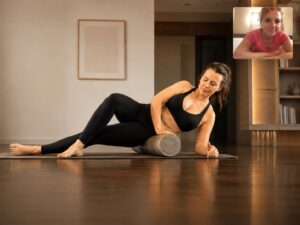
Myofascial release is a technique that manipulates fascial tissue to restore its mobility and elasticity. This can involve using a foam roller (BLACKROLL), balls, the therapist’s hands, or even specific movements.
The mechanism of action includes several components: mechanical separation of “stuck together” layers of fascia, stimulation of hyaluronic acid production, activation of receptors (proprioception, mechanoreception), reduction of the tone of overstrained muscles through neurological reflexes.
BLACKROLL: Tools and Approach
BLACKROLL is a German company that has become the global standard for myofascial release tools. Their rolls and balls were developed in collaboration with scientists and sports physicians.
In my work, I use several BLACKROLL tools: a standard roll for large muscle groups (hips, back), balls of different sizes for point work (feet, shoulder girdle), DuoBall for working along the spine.
Who benefits from myofascial release?
Almost everyone. If you move (or, conversely, move little), your fascia needs care. Myofascial release is especially beneficial for those who lead a sedentary lifestyle, experience chronic muscle pain, exercise regularly (for recovery), are recovering from injuries, or experience morning stiffness.
How I integrate release into my training
In my programs, myofascial release isn’t a separate “procedure,” but an integral part of the training process. At the beginning of a workout, I use it to prepare the body: relieving excess tension, “awakening” the fascia, and improving body awareness. At the end, I use it for recovery and relaxation.
For online classes, a standard BLACKROLL roll and one ball are sufficient—minimal investment with maximum effect.