When I first started teaching online classes in March 2020, during the COVID lockdown, many clients were hesitant to join the new format:
“Well, how can we study normally through a screen? We’ll wait until the studio opens.”
I had my doubts too. It seemed I might miss something, fail to direct it in time, or be unable to convey the nature of the movement without tactile cues and contact.
But there were also clients who were incredibly supportive during that difficult time. They trusted the new format—and we were among the first to transition to online training, even before it became commonplace in the months of subsequent lockdowns.
And quite quickly, I made an unexpected discovery: through the screen, I see a person completely and immediately. I don’t have to be distracted by the position of their feet, “losing” sight of their neck or ribs.
Clients, in turn, began to perform the exercises more attentively than in the gym. There, you always feel like a trainer will come over and correct you at any moment. Online training, however, has added personal responsibility for your own practice—and with it, improved results.
Several years and over 5,000 online training sessions later, I can now honestly answer the question:
Is it possible to train effectively online?
No advertising – just real experience.
Myth #1: “Online is for those who are too lazy to travel.”
People don’t choose online out of laziness. My clients include young mothers who have no one to leave their children with, people with busy work schedules, those who have difficulty getting to the studio due to chronic pain, and those who simply live in another city or country.
Online training eliminates the most energy-consuming part—the commute. This means training becomes regular: you don’t have to cancel due to traffic jams, fatigue after a long day at work, or lack of time. And in Pilates, it’s consistency that produces results.
Myth #2: “The coach can’t see mistakes through the camera.”
In practice, they do. An experienced trainer notices key elements: pelvic position, knee alignment, shoulder engagement, breathing patterns, and overall movement quality. While it’s true that a screen can be more difficult for a client to grasp certain nuances that can be conveyed offline through tactile cues—using the hands. But for most Pilates exercises, this is more than sufficient.
I always ask to position the camera in advance so that the entire body is visible. Usually, placing the mat 1-1.5 meters from the camera is sufficient. And over the years of working online, I’ve learned to read movement in images almost as accurately as in person. It’s simply a different professional skill—and it also develops with experience.
But there are exceptions. Rehabilitation after injuries, acute conditions, and complex physical limitations—these are situations where I truly recommend starting with offline classes. Here, tactile work and the ability to immediately correct hand movements are essential.
Myth #3: “I don’t have the necessary equipment at home.”
In fact, for most Pilates classes, a mat is sufficient.
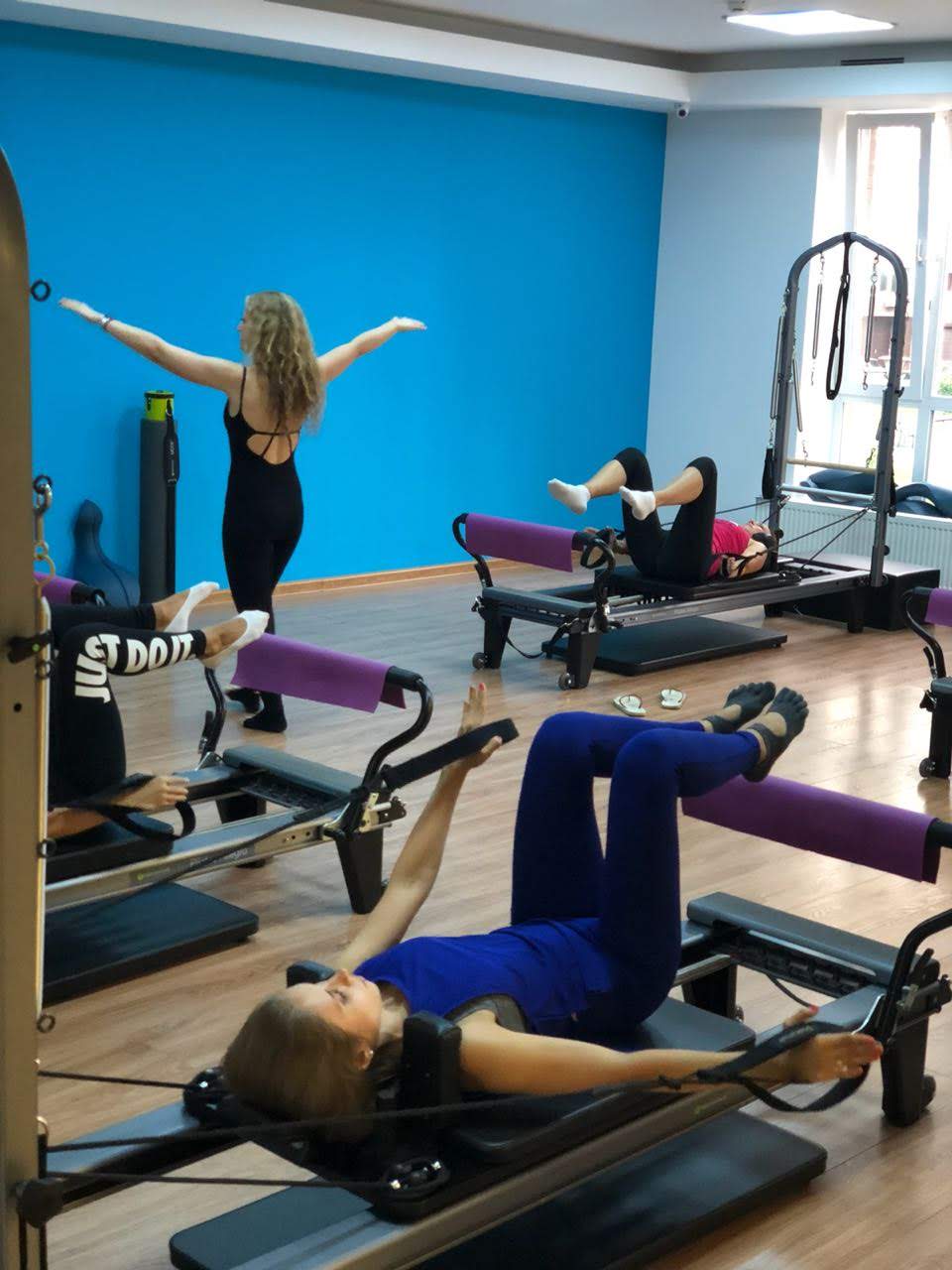
Yes, specialized exercise equipment—a reformer, a Cadillac, a chair—is usually available at the studio. Although some clients eventually buy some smaller equipment for home use, if they have the space and desire to delve deeper into their practice. But that’s the next, more advanced stage.
Mat Pilates, which we begin our online workouts with, is a complete and independent practice. And not a single one of my clients over the years has said they feel “deprived” without a reformer. In many exercises, bodyweight is more than enough to create a good load and resistance.
And then, as they progress, we gradually add props: soft balls, foam rollers, resistance bands, and massage balls for MFR. As new motor skills are developed, so too does the difficulty of the workouts and the variety of practice.
What’s really better than offline?
Let’s be honest: there are things about live training that online training can’t completely replace.
Tactile correction.
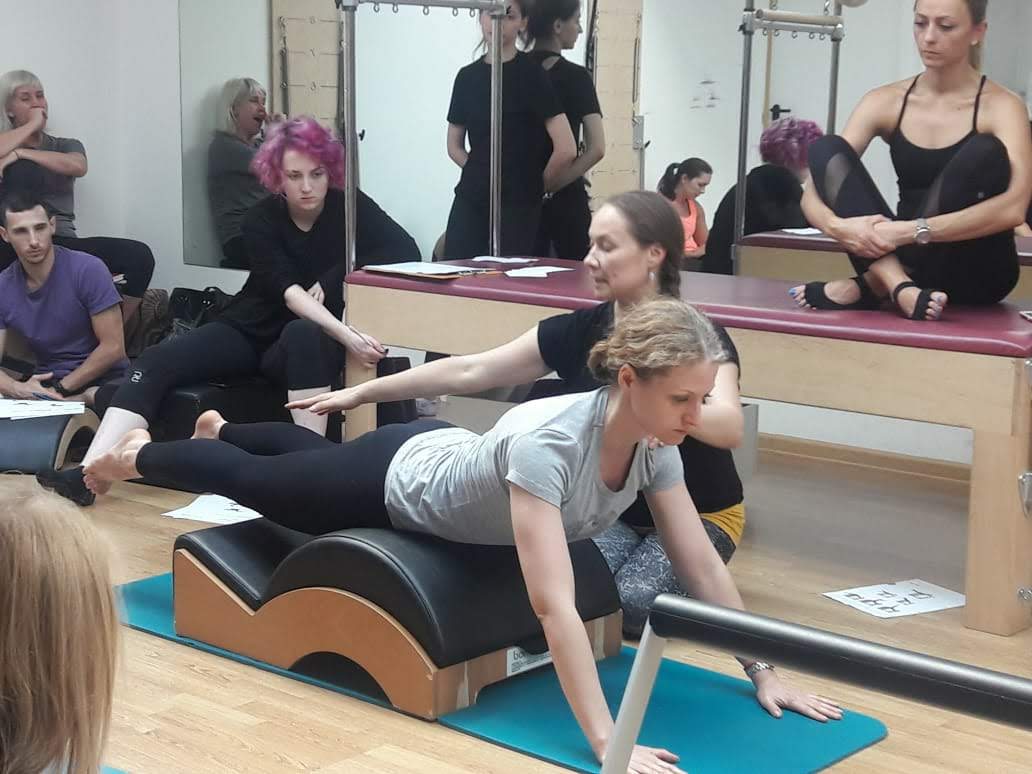
A single touch on a muscle or bony landmark can sometimes provide more information to the nervous system than several verbal instructions. Hands are more effective in helping to adjust the shoulder blade, identify excess tension in the lower back, or find a neutral spine position. In person, such moments often happen more quickly and accurately.
The atmosphere and energy of the group.
Working out in a gym with other people creates a special sense of inclusion. For many, this provides additional motivation, discipline, and a sense of community. However, for some, it’s easier to concentrate at home—without outside noise or comparisons.
Concentration.
At home, there’s always the risk of distraction: the phone, children, thoughts of household chores, or the sudden thought of “I need to preheat the oven.” For some clients, this really gets in the way of fully immersing themselves in the practice. But on the other hand, setting aside an hour just for yourself and agreeing with your family that you won’t be disturbed during this time is also an important part of self-care and working on your boundaries.
What’s really convenient about online
Availability and regularity.
No need to waste time commuting, sitting in traffic, or searching for parking. You just open your laptop and start working out. This makes it much easier to exercise regularly.
The comfort of your own space.
Many clients admit that they find it easier to relax at home and feel less pressure to “match” others. In a familiar environment, it’s easier to focus on the sensations in the body, the breath, and the movement itself—and this directly impacts the quality of the practice.
Flexibility of schedule.
Online training is especially helpful for people with an unstable schedule, children, business trips, or constant travel. When training isn’t tied to a specific location, it becomes much easier to fit it into your life.
So what should you choose?
After 5,000+ online training sessions, my answer is this: online and offline shouldn’t be pitted against each other. They’re not competing formats, but rather tools that can complement each other perfectly.
For many clients, a combination of periodic offline classes—for deeper correction, tactile work, and fine-tuning of movement—and regular online practice—to maintain a rhythm, stay engaged, and integrate movement into real life, not just “ideal conditions”—works perfectly.
Because results in Pilates aren’t determined by the format. They’re determined by consistency, self-care, and the quality of the practice. Whether you practice at home or in a studio is a matter of lifestyle, goals, and personal comfort.